


Introduction
Renting a property is a significant milestone for many individuals, whether they are students moving out for the first time, young professionals relocating for a new job, or families seeking a new home. However, securing a rental property is not always as straightforward as simply signing a tenancy agreement and handing over the keys. In many cases, landlords and letting agents require prospective tenants to provide a "guarantor" before they will agree to let the property.
The concept of a guarantor can often cause confusion for both the tenant seeking one and the individual who is asked to take on the role. A guarantor is essentially a third party, usually a parent, close relative, or friend, who agrees to take on the financial and legal responsibilities of the tenancy if the tenant fails to meet them. By signing a guarantor agreement, this individual provides a safety net for the landlord, ensuring that rent will be paid and any property damage will be covered, even if the tenant defaults.
This comprehensive guide delves deep into the multifaceted role of a guarantor. We will explore exactly why landlords request them, who qualifies to be one, the detailed responsibilities involved before the tenancy even begins, the ongoing obligations during the rental period, and the significant legal and financial implications that come with taking on this substantial commitment.
Why Do Landlords Require a Guarantor?
To understand the role of a guarantor, it is essential first to understand the perspective of the landlord. Renting out a property is a business transaction and an investment. Landlords rely on consistent rental income to cover their own expenses, such as mortgages, property maintenance, and insurance. Any disruption to this income stream, or any unexpected costs due to severe property damage, can cause significant financial hardship for the landlord.
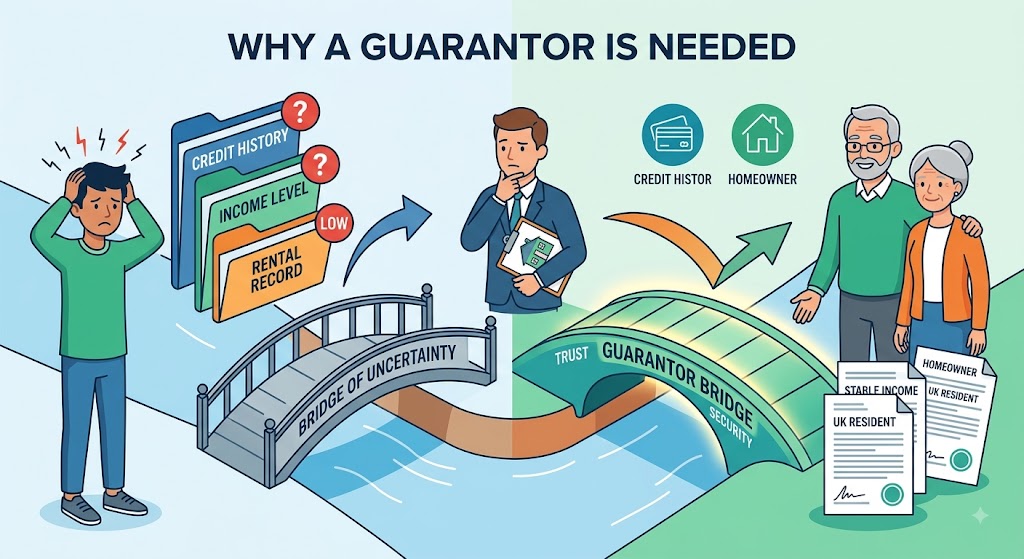
Therefore, landlords use guarantor requirements as a risk mitigation strategy. They typically ask for a guarantor when a prospective tenant is deemed to be a "higher risk." This risk assessment is usually based on the tenant's financial history, employment status, or lack of previous renting experience. Common scenarios where a guarantor is almost always required include:
1. Students: Full-time students usually do not have a steady, full-time income to cover monthly rent. Because they rely on student loans, grants, or part-time work, landlords view them as high-risk tenants.
2. First-Time Renters: Individuals who have never rented before lack a track record of reliable rent payments or positive landlord references. Without this rental history, landlords have no proof of the tenant's reliability.
3. Low Income or Unemployment: If a tenant's income falls below the landlord's required affordability threshold (usually the annual rent multiplied by 2.5 or 3), a guarantor is needed to bridge the gap. Similarly, unemployed individuals or those on housing benefits often need guarantors.
4. Poor Credit History: Prospective tenants with a low credit score, previous bankruptcies, County Court Judgments (CCJs), or a history of missed payments are considered highly likely to default on rent.
5. Foreign Nationals: Individuals who have recently moved to the country may not have a local credit history, making it impossible for landlords to perform standard financial background checks.
Who Can Be a Guarantor?
Not just anyone can step in and act as a guarantor; the individual must meet strict criteria set by the landlord or the referencing agency. Because the guarantor is the ultimate financial safety net, they must demonstrate that they have the means to cover the tenant's liabilities without facing financial ruin themselves.
Typically, a guarantor must be a resident of the same country where the rental property is located. For instance, in the UK, landlords overwhelmingly prefer UK-based guarantors. This is because pursuing a guarantor for unpaid debts through the legal system is much more complicated, expensive, and sometimes impossible if the guarantor lives overseas.
Financially, the guarantor must undergo the same rigorous referencing process as the tenant. They must have a good credit history, free of severe debts or legal financial judgments. Furthermore, they must prove a stable and sufficient income. The affordability threshold for a guarantor is usually higher than that of a tenant—often requiring an annual income of at least 3 to 3.5 times the annual rent of the property.
In many cases, landlords strongly prefer or mandate that the guarantor is a homeowner. Owning property provides an extra layer of security for the landlord; it proves financial stability and means that, in the worst-case scenario where court action is required to recover massive debts, the guarantor has an asset against which a charge can be placed. Usually, parents or older family members step into this role, as they have had the time to build the required financial stability and asset base.
Pre-Rental Responsibilities of a Guarantor
The responsibilities of a guarantor begin long before the tenant moves into the property. The preliminary phase involves a high degree of transparency, paperwork, and legal commitment.
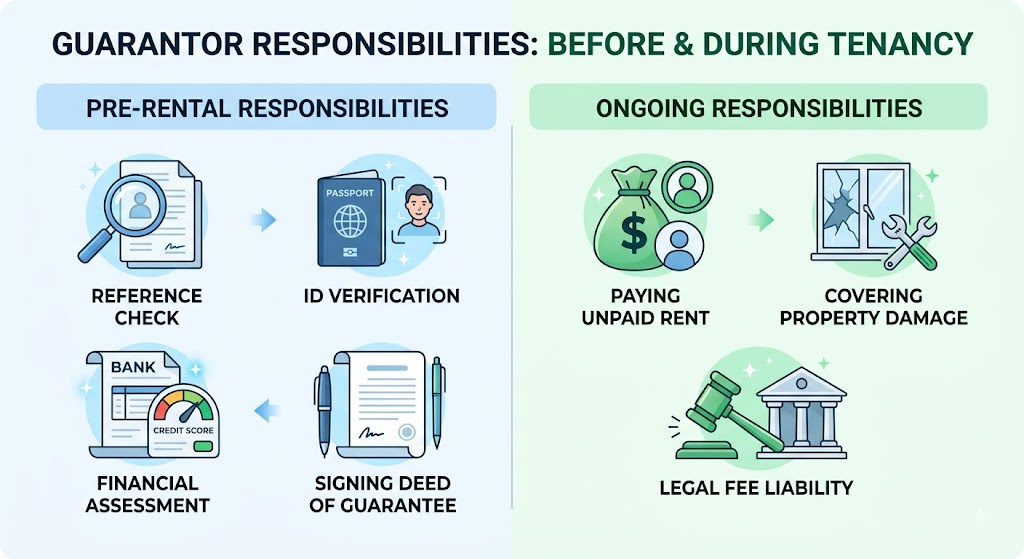
First and foremost, the prospective guarantor must agree to undergo comprehensive referencing. This means they must willingly submit their personal details to a third-party referencing agency. The guarantor must provide proof of identity (such as a passport or driver's license), proof of address (such as recent utility bills), and detailed financial information.
They will need to provide bank statements, payslips, or tax returns to prove their income level. If they are employed, the referencing agency may contact their employer to verify their job security and salary. If they are a homeowner, they may need to provide proof of homeownership, such as a mortgage statement or land registry document. The guarantor must also consent to a hard or soft credit check, which will scrutinize their borrowing history and credit score.
Once the referencing is successfully passed, the most critical pre-rental responsibility occurs: signing the Guarantee Agreement or Deed of Guarantee. This is a legally binding contract between the guarantor and the landlord. Before signing, it is the guarantor's paramount duty to read and thoroughly understand the terms of this document.
The guarantor must check if they are guaranteeing the entire tenancy or just a specific portion (especially relevant in shared housing). They must also understand the duration of their liability—whether it only covers the initial fixed term (e.g., the first 12 months) or if it extends indefinitely into any subsequent rolling (periodic) tenancy. Seeking independent legal advice before signing this deed is highly recommended, as it locks the guarantor into a potentially immense financial obligation.
Ongoing Responsibilities of a Guarantor
Once the tenancy begins, the guarantor essentially remains dormant as long as the tenant fulfills their obligations. However, if the tenant breaches the tenancy agreement, the guarantor's active responsibilities are immediately triggered.
The primary ongoing responsibility is covering unpaid rent. If the tenant misses a rent payment, loses their job, or simply refuses to pay, the landlord has the legal right to bypass the tenant entirely and demand the rent directly from the guarantor. The guarantor is legally obligated to clear these arrears promptly. Failure to do so can result in the landlord taking the guarantor to court, which could lead to County Court Judgments (CCJs), bailiff action, and severe damage to the guarantor's own credit rating.
Beyond rent, the guarantor is also liable for property damage. If the tenant causes damage to the property that exceeds the value of the security deposit, the landlord will send the repair bill to the guarantor. This can range from minor issues, like stained carpets and broken furniture, to major structural damage or the cost of deep cleaning and clearing out abandoned belongings.
Furthermore, if the landlord is forced to take legal action to evict the tenant—perhaps due to anti-social behavior or severe rent arrears—the guarantor can be held responsible for the landlord's legal fees and court costs. These expenses can easily amount to thousands of dollars or pounds, adding a massive financial burden on top of the unpaid rent.
It is crucial to understand that the landlord does not have to exhaust all avenues against the tenant before approaching the guarantor. The guarantor and the tenant are usually "jointly and severally liable" in the eyes of the contract, meaning the landlord can pursue whoever is most likely to pay—which is almost always the financially stable guarantor.
The Complexity of Joint Tenancies
The guarantor's role becomes significantly more complex and risky in the context of joint tenancies, such as shared student houses or properties rented by a group of friends.
When a group signs a single, joint tenancy agreement, they are usually "jointly and severally liable" for the entire rent and condition of the property. This means that if one housemate fails to pay their share of the rent, all the other housemates are legally responsible for making up the shortfall.
Crucially, this principle often extends to the guarantors. If you agree to be a guarantor for your child in a joint tenancy, you might inadvertently be guaranteeing the entire rent for the whole house, not just your child's specific share. If one of your child's roommates drops out of university and stops paying rent, the landlord could legally demand the missing money from you.
To mitigate this severe risk, guarantors should strongly negotiate the terms of the Deed of Guarantee before signing. They should ask the landlord or letting agent to insert a clause that specifically limits their financial liability to their specific relative's share of the rent and their proportional share of any communal property damage. While not all landlords will agree to this limitation, it is a vital step for a guarantor to attempt to protect their own finances.
Risks, Considerations, and Ending the Guarantee
Becoming a guarantor is not a mere formality; it is a profound financial and legal risk. The most obvious risk is the unexpected financial strain. Even the most reliable tenant can fall on hard times due to illness, job loss, or a global economic downturn. The guarantor must genuinely ask themselves: "Can I afford to pay this rent for six months to a year if I absolutely have to?"
There is also a severe risk to the guarantor's credit score and assets. As mentioned, if the guarantor cannot pay the demanded sums, the landlord will take them to court. A resulting court judgment will ruin the guarantor's credit rating, making it difficult for them to get loans, mortgages, or credit cards for years. In extreme cases, a charge could be put on the guarantor's own home.
Furthermore, acting as a guarantor can strain personal relationships. If a parent is forced to pay thousands to cover their adult child's debts, it can cause immense friction, resentment, and a breakdown in family dynamics.
A major concern for guarantors is understanding how and when their liability ends. A guarantor cannot simply "opt-out" or cancel the agreement because they change their mind or because their financial situation changes. The liability typically only ends when the tenancy is legally brought to a close, a new tenancy agreement is signed without the guarantor, or the property is sold. If the initial fixed-term contract ends and rolls into a month-by-month periodic tenancy, the guarantor's liability usually continues automatically. The only way to ensure the obligation ceases is to read the initial contract carefully and perhaps negotiate a strict end date to the guarantee.
Alternatives to Using a Guarantor
For tenants who cannot provide a suitable guarantor, there are alternative options, though they require different types of financial commitment.
1. Rent Guarantor Services: There are private companies that will act as a guarantor for a fee. The tenant pays a non-refundable upfront fee (usually equivalent to 2-4 weeks' rent) to the company, and the company provides the legal guarantee to the landlord.
2. Paying Rent Upfront: If a tenant has significant savings but no regular income (e.g., some international students or retirees), landlords will often waive the guarantor requirement if the tenant pays the entire 6 or 12 months' rent upfront in advance.
3. Larger Deposit: While legislative caps on deposits exist in many regions (like the 5-week cap in the UK), in areas where this is flexible, offering a significantly larger security deposit can sometimes reassure a landlord enough to drop the guarantor requirement.
4. Council or Charity Schemes: Some local authorities or housing charities offer rent guarantee schemes to help vulnerable individuals or low-income families secure private housing.
Conclusion
In summary, a rent guarantor plays an indispensable role in the modern rental market, acting as the ultimate financial safeguard for landlords. For the tenant, having a guarantor unlocks housing opportunities that would otherwise be completely inaccessible. However, for the guarantor, the role involves stringent preliminary checks, a binding legal commitment, and the enduring risk of severe financial liability covering unpaid rent, property damage, and legal fees. It is a position born of trust and generosity, but one that must only be entered into with a complete and sober understanding of the legal contracts involved and the worst-case financial scenarios.


