


In most countries, particularly in common law jurisdictions like the UK, the Tenancy Agreement is the foundational legal document of any rental relationship. If you ask, "How long is a typical tenancy agreement?" the most straightforward answer is: The standard duration is usually 12 months, frequently accompanied by a 6-month break clause.
However, tenancy lengths are not set in stone. The market offers diverse options ranging from a few weeks to several years. Below, we provide an in-depth analysis of typical tenancy durations, why these variations exist, and the crucial details contained within a standard rental contract.
1. Typical Tenancy Durations
6 Months (Short-term Standard): This is often the minimum legal timeframe required for a landlord to regain possession of their property without citing a specific reason (e.g., under a standard UK Assured Shorthold Tenancy). It offers maximum flexibility for tenants who are new to a city, on job probation, or in transition.
12 Months (The Golden Standard): This is currently the most mainstream contract length. Typically, this contract includes a "6-month break clause," meaning that after the first 6 months, either party can legally terminate the agreement without penalty by providing a 1 to 2-month notice.
2 Years or More (Long-term Leases): Ideal for demographics seeking absolute stability, such as families with school-aged children. To hedge against inflation, long-term contracts usually incorporate a "Rent Review Clause," allowing the landlord to adjust the rent annually in line with retail price indices.
Periodic Tenancy (Rolling Contracts): When a fixed-term contract expires and no new agreement is signed, but the tenant remains and continues to pay rent, the contract automatically converts into a rolling periodic tenancy. In this scenario, tenants usually only need to give 1 month's notice to leave, while landlords generally must provide 2 months' notice.
2. Why Are There So Many Duration Variations?
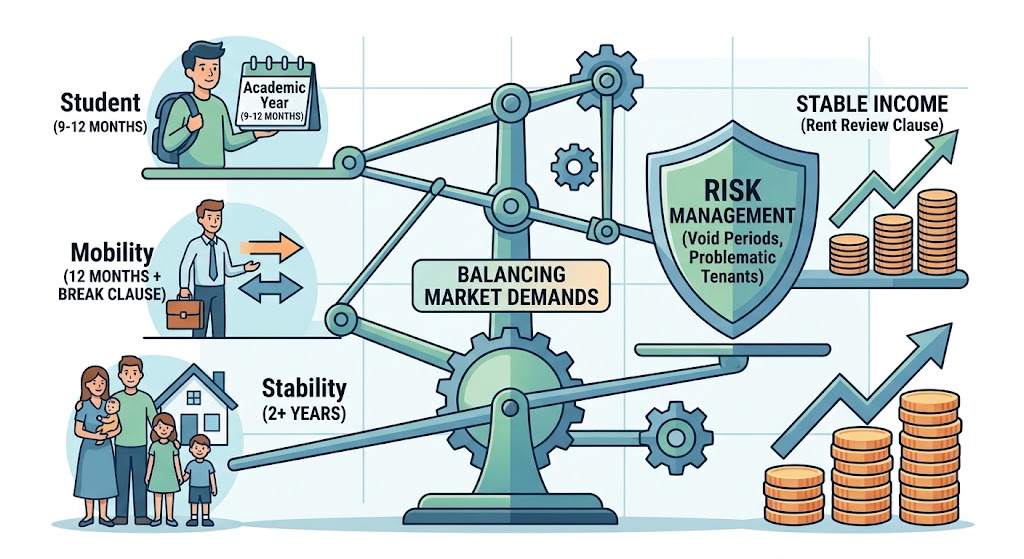
The diversity in tenancy lengths is not random; it is the result of a delicate balance between market demand, risk management, and legal constraints.
A. Balancing Risk and Reward (The Landlord's Perspective)
Landlords primarily fear two things: void periods (no rental income) and problematic tenants. If a contract is too short, landlords face frequent tenant turnovers, incurring high agency fees and vacancy costs. Conversely, if a contract is too long (e.g., 3 years), evicting a tenant who damages the property or falls into rent arrears can result in a lengthy and expensive legal battle. The compromise is the 12-month contract with a 6-month break clause—it guarantees at least half a year of stable income while providing an exit strategy if the tenant proves unreliable.
B. Different Tenant Life Cycles (The Tenant's Perspective)
Different demographics have vastly different housing needs:
· • Students: Usually tied to the academic year. Student accommodations typically strictly offer 9 to 12-month leases without early termination options, as it is notoriously difficult to find replacements mid-term.
· • Young Professionals: Job mobility is high, and they may need to relocate quickly. A 12-month lease with a break clause offers the perfect middle ground.
· • Families: Moving is highly disruptive and costly, especially regarding school catchment areas. They are the primary drivers for long-term leases (2-3 years), preferring stability over flexibility.
C. Market Fluctuations and Inflation
During periods of rapidly rising rents, landlords are reluctant to lock into long-term fixed rates. Conversely, during economic downturns when good tenants are scarce, landlords are more willing to offer longer contracts to secure stable income.
3. Core Components of a Typical Tenancy Agreement
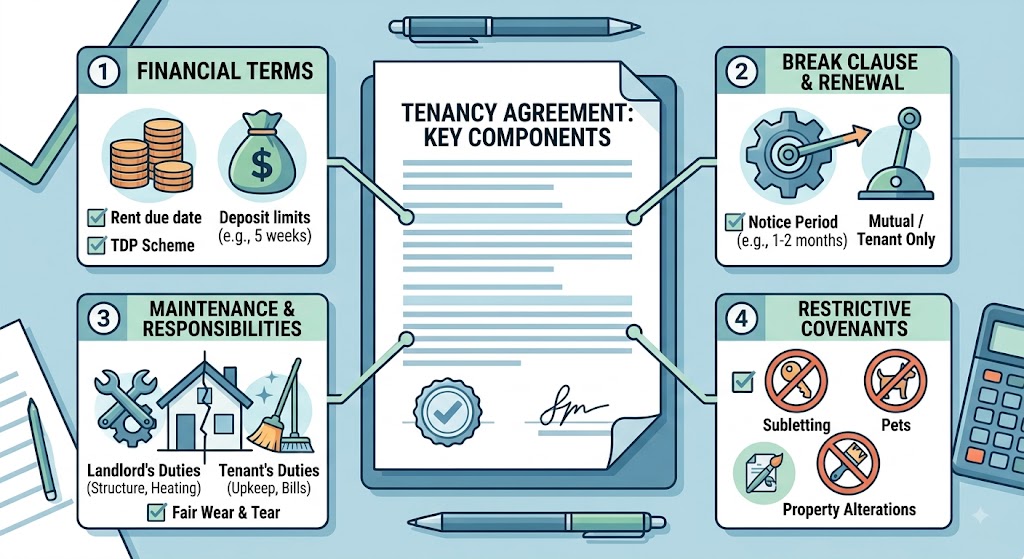
Regardless of whether the lease is for 6 months or 3 years, a robust Tenancy Agreement must contain several core components to protect both parties. Tenants should review these meticulously before signing:
Financial Terms
· • Rent and Payment Dates: Clearly outlines the exact date rent is due each month and the penalties for late payments.
· • Deposit: In jurisdictions like the UK, deposit amounts are legally capped (usually at 5 weeks' rent). Crucially, the contract must state which government-approved Tenancy Deposit Protection (TDP) scheme holds the money. Failure to do so can result in hefty fines for the landlord.
Break Clause and Renewal Options
This is often the most disputed section. The contract must explicitly state whether the break clause is mutual (applicable to both landlord and tenant) or tenant-only. It must also clearly define the required notice period (usually 1 or 2 months).
Maintenance and Responsibilities
· • Landlord's Duties: Responsible for the structural integrity of the building, plumbing, gas, heating systems, and electrical safety.
· • Tenant's Duties: Responsible for day-to-day upkeep (e.g., ventilation to prevent mold, changing lightbulbs), paying utility bills, and maintaining general cleanliness.
· • Fair Wear and Tear: Tenants are not financially responsible for the natural degradation of the property over time (e.g., worn carpets). However, they are liable for malicious damage or negligence.
Restrictive Covenants
These clauses dictate what a tenant cannot do:
· • Subletting: Most contracts strictly prohibit subletting or hosting on platforms like LetUKhome without written consent.
· • Pets: While recent legal shifts encourage landlords to accept pets, default contracts usually still require prior landlord approval.
· • Alterations: Prohibits running a business from the premises or making modifications (like painting walls or drilling holes) without permission.
Conclusion
The typical tenancy agreement has evolved into its current state as a product of legal regulations and human negotiation. As a tenant, understanding the underlying logic of the "12-month contract + 6-month break clause" can help you better assess your risk tolerance. Always ensure the lease duration aligns perfectly with your future plans, and never skip reading the fine print regarding deposits and termination clauses—it is the best defense for your wallet.


