


When individuals decide to purchase or lease real estate together, whether they are married couples, family members, business partners, or simply friends, one of the most critical and often misunderstood legal decisions they must make is how to hold the title to the property. This decision goes far beyond mere paperwork; it fundamentally dictates your legal rights, your financial responsibilities, your ability to sell or borrow against the property, and, crucially, what happens to your ownership share upon your passing.
In common law jurisdictions around the world, the two primary frameworks for co-ownership are Tenancy in Common (TIC) and Joint Tenancy (JT). While they may sound similar to a layperson, their legal implications are vastly different. Choosing the wrong form of ownership can lead to unintended inheritance scenarios, bitter legal disputes among surviving relatives, and complex financial liabilities.
This comprehensive guide will explore the deep structural differences between Tenancy in Common and Joint Tenancy. We will break down the legal prerequisites for each, examine their distinct advantages and disadvantages, and provide extensive real-world examples covering both the purchasing of real estate and the intricacies of residential and commercial leasing agreements. By the end of this document, you will have a thorough understanding of how these ownership structures function in practice.
1. Deep Dive into Joint Tenancy (JT)
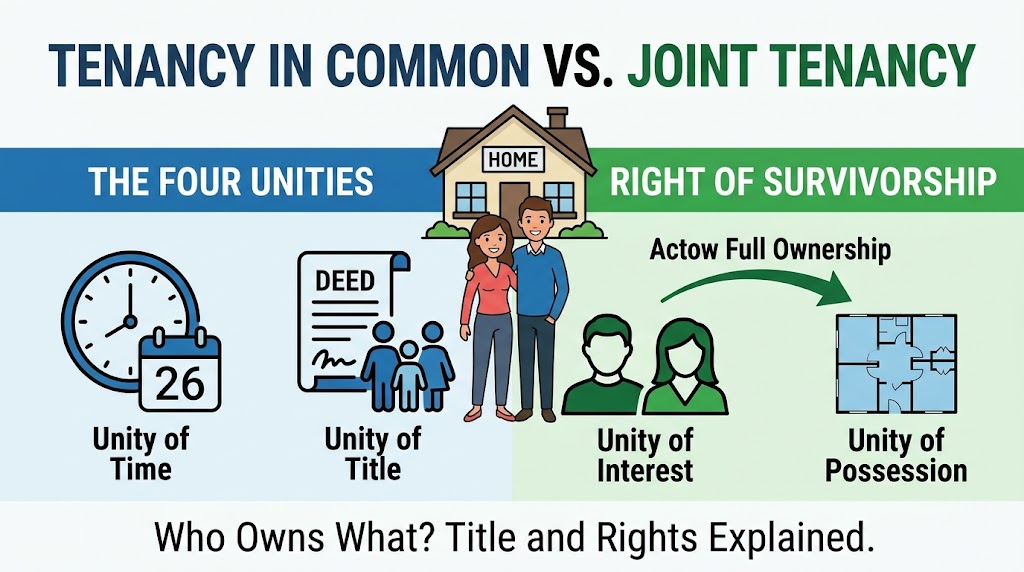
Joint Tenancy is a highly specific form of concurrent estate in which two or more people own a single, unified interest in a property. The absolute most defining characteristic of a Joint Tenancy is the 'Right of Survivorship.' Under this legal doctrine, when one joint tenant dies, their interest in the property does not pass through their will or enter the probate process. Instead, it immediately and automatically transfers to the surviving joint tenant(s). This transfer happens by operation of law the moment the death occurs.
Because of this automatic transfer, Joint Tenancy is incredibly popular among married couples and long-term domestic partners. It ensures that if one partner passes away, the surviving partner assumes full ownership of the family home without having to navigate the often lengthy, public, and expensive probate court system.
The Four Unities of Joint Tenancy
For a Joint Tenancy to be legally valid and enforceable, common law traditionally requires the presence of the 'Four Unities.' If any of these four unities are broken at any time, the Joint Tenancy is instantly severed and typically reverts to a Tenancy in Common. The four unities are:
• Unity of Time: All joint tenants must acquire their interest in the property at the exact same moment. You cannot add a new joint tenant to an existing deed years later without drafting a completely new deed.
• Unity of Title: All joint tenants must acquire their ownership through the exact same legal instrument, which is almost always the same deed or will. They cannot hold separate deeds for the same property.
• Unity of Interest: All joint tenants must hold equal ownership shares. If there are two owners, they each own exactly 50%. If there are four owners, they each own exactly 25%. A Joint Tenancy cannot exist if one person owns 60% and the other owns 40%.
• Unity of Possession: Every joint tenant has an equal and undivided right to possess and enjoy the entire property. No single owner can claim an exclusive right to a specific physical portion of the house or land.
Pros and Cons of Joint Tenancy
The primary advantage is the seamless, probate-free transfer of assets upon death. However, a major disadvantage is the lack of control over inheritance; you cannot leave your share of a Joint Tenancy to anyone other than the co-owners in your will. Furthermore, if one owner falls into severe debt, their creditors might attempt to force a sale of the property to satisfy the debt, impacting the innocent co-owner.
2. Deep Dive into Tenancy in Common (TIC)
Tenancy in Common is a much more flexible and widely applicable form of co-ownership. Unlike Joint Tenancy, there is absolutely no Right of Survivorship in a Tenancy in Common. When a tenant in common passes away, their share of the property is treated just like any other asset in their estate (such as a bank account or a car). It passes according to the terms of their last will and testament, or, if they die without a will, according to the state or country's intestacy laws. This means a TIC owner's share could pass to their children, a sibling, a charity, or anyone else they designate.
Flexibility in Ownership and The Sole Unity
A Tenancy in Common only requires one of the four unities: the Unity of Possession. Just like in a Joint Tenancy, all owners have an equal right to possess and use the entire property. However, the other three unities are not required. This allows for massive flexibility:
• Fractional/Unequal Interests: Owners do not have to hold equal shares. One person can own 80% while two others own 10% each. This is highly beneficial when individuals are contributing different amounts of capital to a purchase.
• Different Acquisition Times: A new tenant in common can buy into the property at any time. The original owners can sell a fraction of their share to a third party without destroying the existing legal structure.
• Independent Financial Actions: A tenant in common can sell, mortgage, or transfer their specific share of the property independently, without requiring the permission of the other co-owners. However, finding a bank willing to mortgage only a fraction of a property can sometimes be practically difficult.
Pros and Cons of Tenancy in Common
The greatest advantage of TIC is flexibility and estate control, making it perfect for investment groups, siblings inheriting a family property, or unmarried partners with distinct financial situations. The main disadvantage is that the property must go through probate upon an owner's death. Additionally, because owners can sell their shares independently, you could theoretically end up co-owning a property with a complete stranger if your original partner sells their interest.
3. Real-World Examples: Buying and Investing
To illustrate how these legal concepts play out in the real world, let us examine several common scenarios related to purchasing real estate.
Scenario A: The Married Couple Buying a Home (Joint Tenancy)
Sarah and Michael are a married couple buying a suburban house for $500,000. They both contribute equally to the down payment and the mortgage. They choose to hold title as Joint Tenants. Twenty years later, Michael tragically passes away. Because they held the property as Joint Tenants, Sarah does not need to go through a lengthy probate court process to secure the house. Michael's interest instantly vanishes, and Sarah becomes the 100% sole owner of the property by right of survivorship. She simply needs to file a death certificate with the local land registry to update the public records.
Scenario B: Business Partners Buying Commercial Real Estate (Tenancy in Common)
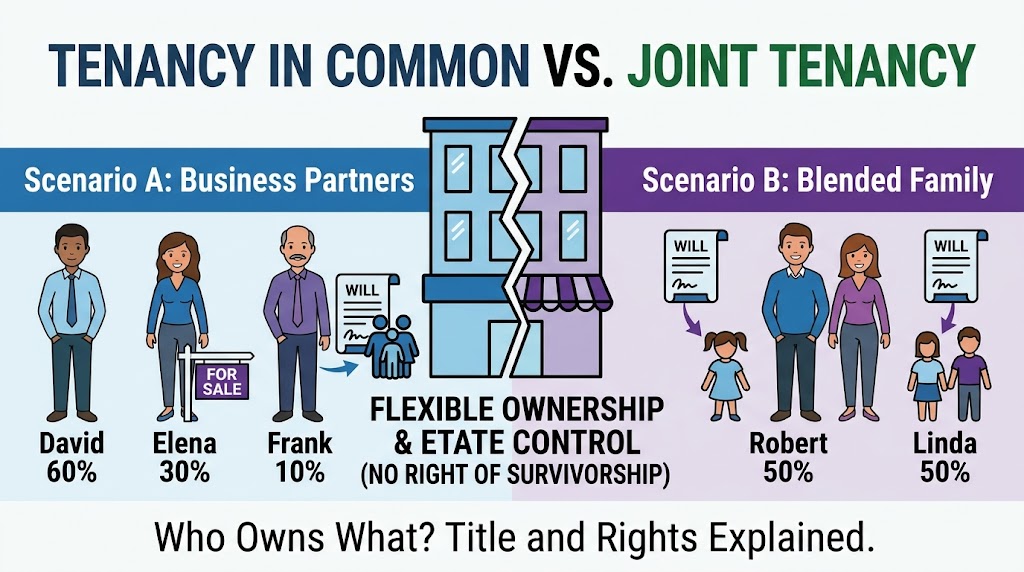
David, Elena, and Frank want to purchase a commercial retail building as an investment. The building costs $1 million. David contributes $600,000, Elena contributes $300,000, and Frank contributes $100,000. Because they are contributing unequal amounts, Joint Tenancy is impossible (as it requires equal shares). Instead, they use a Tenancy in Common. Their deed reflects their financial input: David owns 60%, Elena owns 30%, and Frank owns 10%.
Years later, Elena wants to cash out her investment. Under a TIC, she can legally sell her 30% share to an outside investor, Grace, without needing David or Frank's permission (though they might have a separate private contract, like a Right of First Refusal, that dictates otherwise). Furthermore, if David dies, his 60% share goes to his children, as stipulated in his will, rather than automatically transferring to Elena and Frank.
Scenario C: The Blended Family (Tenancy in Common)
Robert and Linda are in their late 60s, recently married, and buying a condo together. Both have adult children from previous marriages. They each contribute 50% to the condo purchase. If they choose Joint Tenancy, and Robert dies first, Linda owns the condo 100%. When Linda eventually dies, the condo would pass entirely to Linda's children. Robert's children would get nothing from this asset.
To avoid this inequitable outcome, they choose Tenancy in Common, each holding a 50% share. Robert writes his will to state that upon his death, his 50% share of the condo goes to his children. Now, if Robert passes away, Linda still owns her 50%, and Robert's children own the other 50%. (Often, this is paired with a legal agreement allowing the surviving spouse to live in the property until their death, to prevent the children from forcing a sale and evicting the widow).
4. Application to Renting and Leasing Contracts
While the terms Joint Tenancy and Tenancy in Common are heavily used in the context of buying and owning property deeds, their underlying principles strongly influence how residential and commercial leasing agreements are structured. When you rent a property, you are acquiring a leasehold estate, which is a temporary right of possession. How co-tenants share this right is critical.
Joint and Several Liability in Residential Leases
When multiple people (e.g., college students, unmarried friends, or even couples) sign a single residential lease agreement together, the landlord almost universally structures this as a joint tenancy for the leasehold. In the leasing world, this manifests as the doctrine of 'Joint and Several Liability.'
Joint and Several Liability means that every single person who signs the lease is individually responsible for 100% of the rent, and collectively responsible for 100% of the rent. The landlord does not care how the roommates divide the rent internally.
Renting Scenario: The Disappearing Roommate
Alice, Bob, and Charlie rent a three-bedroom apartment for $3,000 a month. They verbally agree to pay $1,000 each. Six months into the lease, Charlie loses his job, stops paying his share, and abandons the apartment. Under Joint and Several Liability, Alice and Bob cannot simply hand the landlord $2,000 and say, 'We paid our share, chase Charlie for the rest.'
The landlord can legally demand the full $3,000 from Alice and Bob. If they fail to pay the full amount, the landlord can initiate eviction proceedings against everyone on the lease and sue Alice and Bob for the missing money. It is entirely up to Alice and Bob to pay the full amount to protect their housing and credit scores, and then they must separately sue Charlie in small claims court to recover his unpaid portion. This legal setup protects landlords by ensuring they have multiple avenues to collect the full debt.
Tenancy in Common in Leasing: Separate Room Contracts
While less common in standard residential housing, a leasing arrangement resembling a Tenancy in Common can be found in specialized situations, such as purpose-built student housing or co-living spaces. In these setups, instead of all roommates signing one master lease for the whole house, Alice, Bob, and Charlie would each sign an independent, separate lease agreement directly with the landlord for their specific bedroom, plus shared access to common areas (kitchen, living room).
If Charlie stops paying rent in this scenario, the landlord can only evict Charlie. Alice and Bob are completely shielded from Charlie's financial default because they do not share Joint and Several Liability. Their only legal obligation is their individual lease.
5. Severing a Joint Tenancy and Legal Complexities
It is important to note that a Joint Tenancy is not always permanent. In many jurisdictions, a joint tenant can unilaterally sever the joint tenancy, effectively converting it into a Tenancy in Common. This is usually done by legally transferring their share to themselves or a third party, thereby breaking the 'Unity of Time' and 'Unity of Title.'
For example, if a married couple owns a home as Joint Tenants, and they are going through a bitter divorce, one spouse might legally sever the joint tenancy behind the scenes. By converting it to a Tenancy in Common, they ensure that if they die before the divorce is finalized, their half of the property goes to their children or designated heirs, rather than automatically passing to the estranged spouse.
Furthermore, situations can arise where owners in a Tenancy in Common simply cannot agree on the management or sale of a property. If one TIC owner wants to sell the whole building, but the other refuses, the legal remedy is a 'Partition Action.' This is a lawsuit where a judge will physically divide the property if possible, or more commonly, force the sale of the entire property at auction and distribute the proceeds according to ownership percentages.
Conclusion
In summary, the distinction between Joint Tenancy and Tenancy in Common is a foundational concept in property law that carries massive financial and personal implications. Joint Tenancy offers the distinct advantage of the right of survivorship, providing a streamlined, probate-free transition of wealth that is highly favored by spouses and life partners. Tenancy in Common sacrifices this survivorship right in exchange for ultimate flexibility, allowing for unequal ownership shares and precise control over inheritance, making it the preferred vehicle for business partners, investors, and blended families.
Similarly, understanding how these concepts translate into 'Joint and Several Liability' when signing lease agreements is crucial for anyone renting property with roommates. Given the complexity of local real estate laws, tax implications, and estate planning nuances, anyone purchasing property with another person should consult with a qualified real estate attorney or estate planner to ensure their title is held in a manner that perfectly aligns with their financial realities and long-term family goals.


