


The relationship between a landlord and a tenant in the United Kingdom is governed by a strict set of laws designed to balance the property owner's investment rights with the tenant's fundamental human right to a private home. At the very foundation of UK tenancy law is the 'implied covenant of quiet enjoyment.' This means that once a tenant signs a tenancy agreement and moves into a property, that space becomes their exclusive home. They are legally entitled to live there peacefully, without unnecessary interference, harassment, or unannounced visits from their landlord or letting agent.
One of the most frequent sources of tension in the private rented sector revolves around the rules of access. Tenants often wonder: Can my landlord simply let themselves in with a spare key? Can they enter the property without giving 24 hours' written notice? In England and Wales, the answer is a resounding no, save for genuine, life-threatening emergencies. The idea that a landlord can drop by unannounced simply because they own the bricks and mortar is a widespread myth.
This comprehensive guide explores the strict legal frameworks in the UK—specifically the Landlord and Tenant Act 1985, the Housing Act 1988, and the Protection from Eviction Act 1977—that dictate exactly when a landlord can enter, when they cannot, and the specific rights a UK tenant has to refuse entry.
The Statutory Baseline: 24 Hours' Written Notice
Under Section 11 of the Landlord and Tenant Act 1985, landlords have a strict legal obligation to keep the structure and exterior of the property in good repair, along with keeping installations for gas, electricity, water, and heating in working order. To fulfill these duties, Section 11(6) of the same Act grants landlords a limited, statutory right of entry to inspect the property's condition or carry out these necessary repairs.
However, this right of entry is strictly conditional. To legally enter the property for an inspection, maintenance, or a safety check (such as an annual Gas Safety Certificate), the landlord or their agent MUST:
1. Give at least 24 hours' notice.
2. Provide the notice in writing (a formal letter, an email, or a text message all legally qualify).
3. Propose a visit at a "reasonable time of day" (e.g., standard working hours, not 11:00 PM or 6:00 AM).
Notice must be genuine and advance. A landlord texting at 8:00 AM to say they are arriving at 9:00 AM does not satisfy the 24-hour requirement. Furthermore, even with 24 hours' written notice, the landlord still fundamentally needs the tenant's permission to cross the threshold.
When Can a Landlord Enter WITHOUT Notice?
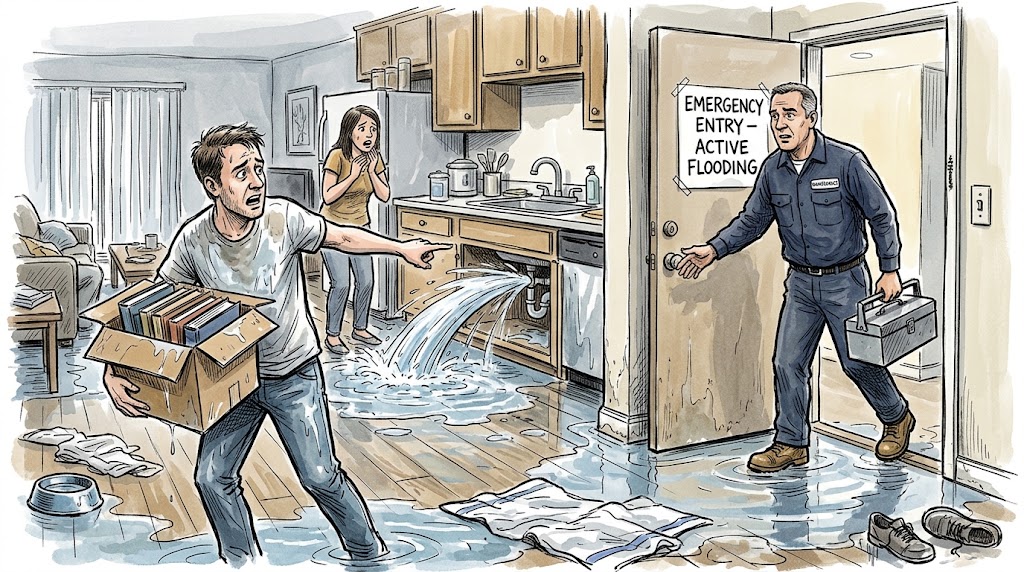
In the UK, the only legally protected exception to the 24-hour written notice rule is a genuine emergency. If an incident poses an immediate, severe risk to life, safety, or the structural integrity of the property (or neighbouring properties), a landlord or emergency services may force entry without any prior notice or permission.
Legitimate emergencies include:
- A suspected gas leak or high levels of carbon monoxide.
- A fire breaking out in the property.
- Severe flooding, such as a burst pipe that is actively damaging the property or leaking into the flat below.
- Structural collapse or severe damage from a storm making the property unsafe.
- A serious security breach, such as a smashed front door or ground-floor window.
It is crucial to understand what does NOT constitute an emergency. A broken boiler in the middle of winter is highly inconvenient and urgent, but it is not a statutory emergency that grants a landlord the right to kick down the door or let themselves in unannounced while the tenant is at work. Routine repairs always require standard notice.
When Can a Tenant Legally Refuse Access?
Because a tenancy agreement grants the tenant exclusive possession of the property, the tenant has the ultimate say over who enters their home. Even if a landlord gives perfect 24-hour written notice, a tenant can still legally refuse entry under various circumstances. The right to refuse generally falls into two categories: reasonable refusal and absolute refusal.
1. Refusal Due to Invalid Notice
If a landlord turns up unannounced, or gives only a few hours' notice verbally over the phone, the tenant is entirely within their rights to keep the door shut. The landlord has not met the statutory requirements of the Landlord and Tenant Act 1985, and entering without consent would be trespassing.
2. Refusal Due to Inconvenience (Rescheduling)
Tenants work, have families, and have private lives. If a landlord gives 24 hours' written notice for a routine repair on a Tuesday afternoon, but the tenant works night shifts and will be sleeping, or simply prefers to be present while contractors are in their home and cannot get time off, the tenant can refuse that specific time. In these cases, the tenant should not outright block the repair, but they have the legal right to push back and say: "That time is not convenient for me, let us reschedule for Thursday morning."
3. Absolute Refusal for Viewings (Estate Agents and Buyers)
This is a critical distinction in UK law. While Section 11 of the Landlord and Tenant Act grants landlords a right to access the property for repairs and condition inspections, it grants NO automatic statutory right for viewings.
If a landlord is selling the property or looking for new tenants, they must have the sitting tenant's explicit agreement for every single viewing. Even if the tenancy agreement contains a clause stating "the tenant must allow viewings in the last two months of the tenancy," the tenant's common law right to quiet enjoyment supersedes this contract clause. If a tenant does not want strangers walking through their home, they can legally refuse all viewings, and the landlord cannot force entry. While it is often best practice to allow reasonable viewings to maintain a good relationship, the legal power to refuse lies entirely with the tenant.
The Consequences of Refusing Access for Repairs
While tenants can refuse access for viewings without legal penalty, refusing access for essential repairs and safety checks is different. Under Section 16 of the Housing Act 1988, tenants have an obligation to allow landlords "reasonable facilities" to execute their statutory repair duties.
If a tenant persistently and unreasonably refuses access to a landlord trying to fix a leaking roof, or more importantly, trying to carry out the legally mandated annual Gas Safety check, the tenant puts themselves at risk. A landlord cannot force their way in, but they can apply to the courts for an injunction to gain access. Furthermore, persistent unreasonable refusal is considered a breach of the tenancy agreement. A landlord could potentially use this as grounds for eviction (Ground 12 for breach of tenancy obligations) under a Section 8 notice.

Illegal Entry and Landlord Harassment in the UK
If a landlord ignores the law, uses a spare key to let themselves in without 24 hours' written notice, or repeatedly turns up unannounced demanding entry, they are committing a criminal offence.
Under the Protection from Eviction Act 1977, entering a tenant's home without permission and without proper notice, or acting in a way that interferes with the peace and comfort of the tenant, constitutes harassment. Having a spare key is for emergencies only; it is not an open invitation for the landlord to treat the flat as if they still live there.
If a UK tenant is subjected to illegal entry, they should:
- Document everything: Keep a log of all unannounced visits, times, and any correspondence.
- Change the locks: Tenants in the UK are generally legally entitled to change the locks to secure their home, provided they do not damage the door and ideally replace the original lock when moving out (check the specific tenancy agreement for restrictive clauses, though quiet enjoyment often overrides them if harassment is occurring).
- Report to the Council: The Private Sector Housing team or Environmental Health department at the local council has the power to investigate and prosecute landlords for harassment under the Protection from Eviction Act.
- Seek Advice: Charities like Shelter or Citizens Advice provide vital legal support for tenants facing landlord intrusions.
Conclusion
In the UK, the phrase 'my house, my rules' does not apply to private landlords once a tenancy has begun. The laws heavily favor the tenant's right to privacy and quiet enjoyment of their home. A landlord cannot enter the property without at least 24 hours' written notice, save for extreme, life-threatening emergencies.
Tenants hold the legal power to control who enters their home and when. While it is always advisable to cooperate reasonably with landlords for necessary maintenance and statutory safety checks, tenants should never feel pressured to accept unannounced visits, inconvenient repair schedules, or unwanted viewings. By understanding the robust protections offered by the Landlord and Tenant Act 1985 and the Protection from Eviction Act 1977, UK tenants can confidently protect their sanctuary.


