


On October 28, 2026, the UK Autumn Budget confirmed a policy change directly impacting residential landlords: starting April 6, 2027, rental income for individual landlords will be subject to three tax rates—$24\%$, $44\%$, and $49\%$. These rates reflect a 4 percentage point increase across each of the current $20\%$, $40\%$, and $45\%$ tax bands. This policy applies equally to resident and overseas landlords who hold and let residential property in the UK under individual ownership.
Meanwhile, market rents continue to rise. Data from the Office for National Statistics (ONS) published on November 18, 2026, shows that as of October 2026, the average monthly rent in the UK reached $£1,411$, up $3.8\%$ year-on-year. Based on the average UK house price of $£273,000$ (ONS, September 2026), the average gross rental yield is approximately $6.2\%$.
With both gross rental income and tax rates rising, landlords must focus on their actual "after-tax cash flow." This article breaks down the tax landscape into eight key questions.
1. What tax rates apply to rental income? 24%/44%/49% from April 2027
The UK does not have a separate "rental income tax." Instead, rental income is included in individual Income Tax filings and taxed on a progressive scale.
Key figures:
- Current rates: Individual rental income is taxed at $20\%$, $40\%$, and $45\%$.
- New rates (from April 6, 2027): Rental income will be subject to $24\%$, $44\%$, and $49\%$.
- Tax Bands: These rates correspond to existing income tax brackets—Basic Rate, Higher Rate, and Additional Rate.
- Applicability: Applies to residential properties owned and let by individuals (not limited companies).
Note that rental income is added to other income sources (such as salary or pension) to determine total taxable income. Therefore, your tax bracket is determined by your overall income, not rental earnings alone.
2. Can mortgage interest still be fully deducted? No, only a 20% tax credit applies
This is one of the most common calculation mistakes made by landlords.
Since April 2020, mortgage interest for individual landlords can no longer be deducted as an allowable expense. Instead, landlords receive a flat $20\%$ tax credit based on their interest expenses. Consequently, whether a landlord falls into the $40\%$ or $45\%$ bracket (or future $44\%$ / $49\%$ bands), the tax relief on mortgage interest remains capped at $20\%$.
This rule (commonly known as Section 24) means that landlords with high leverage and high income face heavier tax burdens. Landlords holding properties through a limited company (Special Purpose Vehicle / SPV) are not subject to Section 24, but company ownership involves Corporation Tax and Dividend Tax, requiring custom financial modeling.
There is no universal rule that "transferring property to a limited company is always more tax-efficient." The choice depends on loan balances, rental volume, capital gains plans, and dividend strategies.
3. How do overseas landlords collect rent and file taxes? Check NRLS first
Landlords who are not tax residents in the UK fall under the Non-Resident Landlord Scheme (NRLS).
Key rules:
- Without approval: Letting agents or tenants must withhold tax at the basic rate from rent payments and remit it directly to HMRC.
- NRLS approval: Landlords can apply for NRLS approval from HMRC. Once approved, rent can be collected gross (without tax deducted), with final tax calculated via annual filing.
- Filing obligation: Regardless of approval status, overseas landlords must file a Self Assessment tax return for UK rental income.
- Filing deadline: The annual Self Assessment deadline is January 31 following the end of the tax year.
A frequent mistake among overseas landlords is assuming that "agent withholding covers everything." Withholding is merely a prepayment; an annual tax return must still be submitted. Failure to file can lead to penalties and interest.
4. Which expenses are allowable for tax deduction? Six common categories
Tax is not calculated directly on total gross rent; legitimate allowable expenses can be deducted first.
Common allowable expenses include:
- Agent management fees and letting commissions
- Property insurance (Landlord insurance, Building insurance)
- Repairs and maintenance (excluding capital improvements)
- Deductible portions of Ground Rent and Service Charges
- Accountancy and tax filing fees
- Council Tax (where paid by the landlord)
Landlords with gross rental income under $£1,000$ per year may opt for the $£1,000$ Property Allowance instead of deducting actual expenses (the two methods cannot be combined).
It is essential to distinguish between "repairs" and "improvements": replacing a broken boiler is a repair and is deductible; upgrading an old boiler to a higher-efficiency system is generally considered a Capital Improvement and cannot be fully deducted in the current tax year.
5. What compliance costs should landlords factor in?
Taxation is only part of ownership costs; compliance expenditures also impact net returns.
Typical operational requirements for letting a UK property include:
- Tenancy Deposit Protection (TDP): Deposits must be secured in a government-approved scheme. In England, deposits are capped at 5 weeks' rent (for annual rents below $£50,000$) or 6 weeks' rent.
- Energy Performance Certificate (EPC): Must meet current minimum efficiency standards.
- Electrical Safety Report (EICR): Inspection required at mandated intervals.
- Gas Safety Certificate: Mandatory annual inspection.
- Safety Alarms: Smoke and carbon monoxide detectors installed according to regulations.
- Right to Rent Checks: Mandatory tenant identity verification.
From May 1, 2026, key provisions of the England Renters' Rights Act take effect, restricting landlord operational flexibility on rent adjustments, notice periods, and advance payments: rent can only be increased once per year, no rent increases are permitted in the first year of tenancy, and increases require two months' notice using the statutory Section 13 procedure.
6. After-Tax Cash Flow Table: Calculating the impact of new rates
Based on the ONS average monthly rent of $£1,411$ (October 2026), annual rental income is approximately $£16,932$. Assuming no allowable expenses and that rental income falls entirely within a single tax bracket, the estimated tax liability and net income across the three new brackets are as follows:
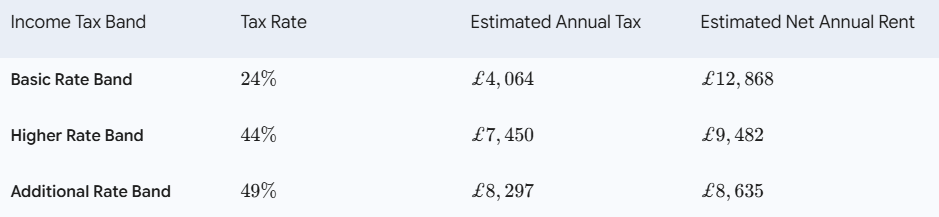
Note: This table is a simplified scenario. Actual tax liability depends on overall personal income, allowable deductions, mortgage interest tax credits, and personal allowance.
Key Takeaway: The net income difference between the $24\%$ and $49\%$ brackets on the same property is nearly $£4,200$, whereas annual rent growth typically ranges between $3\%$ and $4\%$ ($£500$ to $£700$). The impact of tax rate changes on net yields significantly outweighs a standard rent increase.
7. Three action steps for landlords before April 2027
- Organize Financial Ledgers: Consolidate rental income, allowable expenses, and mortgage interest records into a clear annual ledger. Under higher tax rates, unclaimed expense deductions result in greater net losses.
- Re-evaluate Ownership Structure: Tax liabilities vary significantly between individual, joint, and limited company (SPV) ownership depending on income levels. Decisions should be based on personalized calculations rather than general assumptions.
- Audit Compliance Validity: Check expiration dates on EPCs, EICRs, and Gas Safety Certificates. Expired documents can affect legal letting eligibility and insurance claims.
8. Legal & Compliance Disclaimer
UK residential letting regulations, local licensing rules, and tax laws are subject to ongoing updates. Overseas landlords must also consider cross-border filings and double taxation agreements. This document is provided for market informational purposes only and does not constitute formal tax or legal advice. Please consult official HMRC guidance or a licensed tax advisor for specific tax obligations and calculations.
Let UK Home: Comprehensive Property Management Services
Let UK Home specializes in UK residential letting and property management services for domestic and overseas landlords.
Our services include:
- Property appraisal and market rent pricing advice
- Professional photography, listing marketing, and tenant sourcing
- Tenant background checks and referencing support
- Tenancy agreements, check-in, and check-out inspections
- Deposit protection, utility handling, and record keeping
- Routine maintenance, emergency repairs, and remote property visits
- Coordination of licensing, EPC, EICR, and compliance checks
- Annual financial reporting for overseas landlords to assist tax filings
For non-resident landlords, professional management provides more than just rent collection—it creates an auditable, end-to-end management record. Contact Let UK Home to discuss customized property management solutions for your UK real estate portfolio.
Data Sources: UK HM Treasury Autumn Budget 2026 (October 28, 2026), ONS "Private rent and house prices, UK" (November 18, 2026), HMRC Non-Resident Landlord Scheme (NRLS) Guidelines, GOV.UK Renters' Rights Act updates. Compiled by the Let UK Home team.


