


For decades, navigating the private rented sector (PRS) in the United Kingdom has often felt like walking a tightrope for millions of tenants. Insecurity, unpredictable rent hikes, and substandard living conditions have been persistent challenges. However, the landscape of tenant rights is undergoing a historic transformation. The UK Renters' Rights Act, which officially takes effect on May 1, 2026, represents one of the most significant overhauls of housing legislation in a generation. Designed to rebalance the relationship between renters, landlords, and letting agents in England, this landmark legislation introduces a robust framework of protections.
If you are currently renting or planning to rent a home, understanding "what rights do tenants have" under this new system is crucial. This comprehensive guide breaks down the core provisions of the Renters' Rights Act, explaining exactly how your rights are expanding, how you are protected from unfair practices, and what this means for the future of private renting in the UK.
1. The Abolition of 'No-Fault' Evictions (Section 21)
Perhaps the most celebrated and highly anticipated change in the Renters' Rights Act is the complete abolition of Section 21 evictions, commonly known as "no-fault" evictions. Under the previous rules established by the Housing Act 1988, a landlord could issue a Section 21 notice to evict a tenant with just two months' notice, without providing any reason whatsoever. This arbitrary power created a pervasive sense of insecurity, discouraging tenants from complaining about poor conditions out of fear of retaliatory eviction.
Under the new legislation, Section 21 notices are permanently banned. Landlords and letting agents in England will no longer be able to evict tenants on a whim. Instead, if a landlord wishes to regain possession of their property, they must provide a specific, legally binding reason—such as wanting to sell the property, moving in themselves, or citing severe tenant fault like significant rent arrears or anti-social behaviour.
Furthermore, the Act introduces a crucial 12-month protected period at the beginning of a new tenancy. During this first year, landlords cannot evict tenants under the grounds of moving in or selling the property. Even when valid grounds are used after this period, the notice period has been extended to four months, giving displaced tenants ample time to find a new home and drastically reducing the risk of sudden homelessness.
2. The End of Fixed-Term Contracts and the Rise of Assured Periodic Tenancies
Historically, most private renters signed an Assured Shorthold Tenancy (AST) agreement with a fixed term, typically six to twelve months. This meant tenants were locked into paying rent for that entire period, regardless of whether their personal circumstances changed or the property fell into disrepair.
The Renters' Rights Act abolishes these rigid fixed-term tenancies. As of May 1, 2026, all new and existing private tenancies will automatically convert into rolling Assured Periodic tenancies. This means the tenancy will simply roll on a monthly (or weekly) basis without a set end date.
This monumental shift grants tenants unprecedented flexibility. If you experience a major life event—such as a relationship breakdown, a new job opportunity in a different city, or the chance to buy your first home—you are no longer trapped in a restrictive contract. Tenants will have the legal right to end their tenancy at any time by providing just two months' written notice to their landlord. The tenancy will only end when the tenant gives notice, or if the landlord successfully proves a valid legal ground for eviction in court.
3. Putting an End to Rental Bidding Wars
In highly competitive rental markets across the UK, prospective tenants have frequently been forced into "bidding wars," where landlords and letting agents encourage applicants to offer more than the advertised rent to secure a property. This practice has artificially inflated rental prices and locked low-income families out of the market.
The new legislation tackles this aggressively. It is now strictly illegal for landlords or letting agents to ask for, encourage, or even accept offers that exceed the publicly advertised rental price. Every property listed for rent must have a clear asking price, ensuring a fairer and more transparent application process for everyone. Furthermore, the Act bans the practice of demanding extortionate amounts of rent in advance. Landlords will only be permitted to request a maximum of one month's rent in advance once the tenancy agreement is signed, preventing renters from being priced out by massive upfront costs.
4. Fairer Rent Increases and the Section 13 Notice
Unexpected and exorbitant rent increases have been a major driver of the cost-of-living crisis for private renters. The Renters' Rights Act puts strict parameters around how and when a landlord can increase the rent.
Once the Act is in force, landlords will be limited to increasing the rent only once every 12 months. Moreover, they cannot simply demand more money via an informal email or text message. Any rent increase must be formally proposed using a Section 13 notice—a legal document that gives the tenant at least two months' advance warning of the proposed hike.
Crucially, if a tenant feels the proposed rent increase is unreasonable and exceeds the current local market rate for a similar property, they have the right to challenge it at a First-tier Tribunal. This ensures that rent increases reflect genuine market changes rather than arbitrary demands, protecting tenants from being economically forced out of their homes.
5. Outlawing Blanket Bans and Discrimination
For years, certain demographics have faced systemic discrimination when trying to access the private rented sector. It was common to see property listings explicitly stating "No DSS" (referring to those receiving housing benefits or Universal Credit) or "No Kids."
The Renters' Rights Act makes it a strict legal offence for landlords and letting agents in England to put up discriminatory barriers against prospective tenants who have children or who are in receipt of state benefits. Everyone deserves a fair chance to secure a safe and stable home. Local authorities have been granted enhanced enforcement powers to crack down on these illegal practices, with the ability to issue hefty fines of up to £7,000 for landlords found guilty of discrimination.
6. The Right to Request a Pet
Historically, finding a pet-friendly rental property in the UK has been exceptionally difficult, leading to heartbreaking situations where tenants had to give up their beloved companions to secure housing. The new legislation changes the default stance on pets in the private rented sector.
Tenants now hold the statutory right to request permission to keep a pet in their home, and landlords are legally prohibited from unreasonably refusing this request. While landlords cannot issue a blanket ban, they are permitted to request that the tenant obtains specialized pet insurance to cover any potential damage the animal might cause to the property. If a landlord refuses a pet request and the tenant believes the refusal is unfair, the tenant can challenge the decision through the new ombudsman service.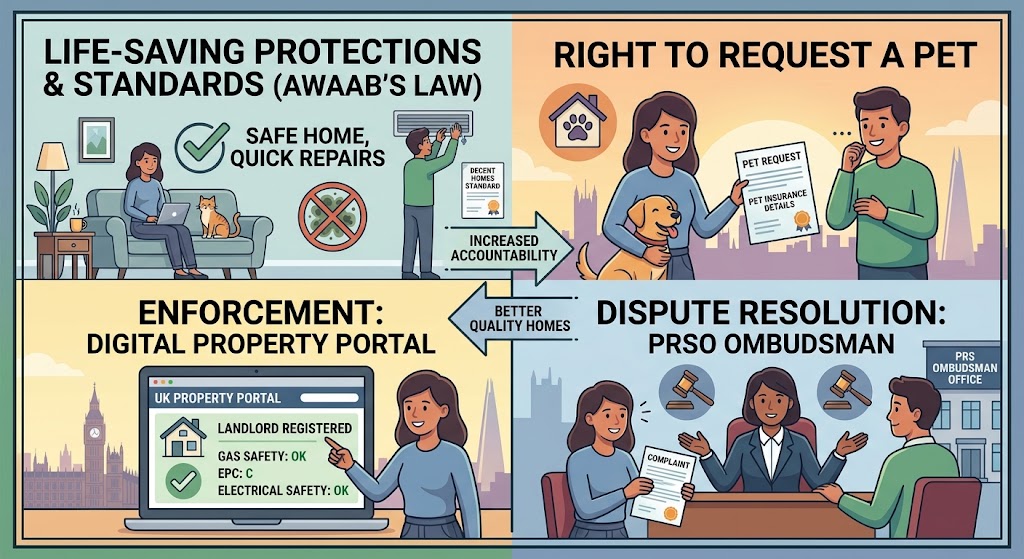
7. Elevating Housing Standards: Decent Homes Standard and Awaab's Law
Security of tenure means little if the property itself is unsafe or hazardous to a tenant's health. The Renters' Rights Act takes aggressive steps to improve the physical condition of rental properties across the nation.
First, it applies the Decent Homes Standard to the private rented sector for the first time. This standard, which previously only applied to social housing, mandates that properties must be safe, warm, and in a reasonable state of repair.
More urgently, the Act introduces Awaab's Law to private rentals. Named after Awaab Ishak, a toddler who tragically died due to prolonged exposure to severe mould in a social housing flat, this law imposes strict legal timeframes on landlords to investigate and rectify dangerous health hazards. If a tenant reports severe damp, mould, unsafe heating, electrical risks, or pest infestations, the landlord is legally obligated to take swift action. Failure to adhere to these strict deadlines allows tenants to take their landlord to court for breach of contract, potentially resulting in compensation or a court order forcing the repairs.
8. Enhanced Enforcement: The Ombudsman and the Property Portal
To ensure these new rights are more than just words on paper, the UK government is introducing new infrastructure to enforce compliance and resolve disputes.
A new Private Rented Sector Ombudsman will be established. All private landlords will be legally required to join this ombudsman scheme. This provides tenants with a free, impartial, and binding resolution service for complaints about their landlord's behaviour, property maintenance, or unfair practices. This is a massive step forward, as it allows tenants to seek justice without the daunting prospect and expense of going through the traditional court system.
Additionally, a comprehensive digital Property Portal (effectively a national landlord database) will be created. Landlords will be required to register themselves and their properties on this portal, uploading crucial compliance documents such as Gas Safety certificates, Energy Performance Certificates (EPCs), and evidence of electrical safety. This portal will be accessible to prospective tenants, empowering them to run background checks on a property and a landlord's compliance record before signing a tenancy agreement.
9. Strengthened Protections for Rent Arrears
While the Act provides landlords with mandatory grounds to evict tenants who fall significantly behind on rent, it also introduces vital safeguards for tenants experiencing temporary financial hardship. Under the new rules, the mandatory threshold for eviction due to rent arrears has been increased from two months to three months' worth of unpaid rent. Furthermore, the eviction notice period for this ground has been doubled from two weeks to four weeks. This adjustment is designed to give tenants struggling with temporary financial shocks a realistic window to arrange debt repayment plans, seek financial advice, or access government support, thereby preventing viable tenancies from collapsing into homelessness.
10. Mandatory Written Tenancy Information
Transparency is at the heart of these reforms. From May 2026, landlords are legally obliged to provide all new tenants with a comprehensive, written Statement of Terms. This document must clearly outline the fundamental mechanics of the tenancy, including the exact rent amount, payment dates, the deposit protection scheme used, and a clear division of repair responsibilities. For existing tenants transitioning to the new periodic system, landlords face penalties if they fail to provide the government-mandated Information Sheet explaining these new rights by May 31, 2026.
Conclusion
The Renters' Rights Act heralds a new era for the UK housing market. By shifting away from an environment heavily skewed in favour of property owners, the legislation establishes a fairer, more balanced system. Tenants are no longer treated as transient occupants who can be removed at a moment's notice, but as valued customers entitled to secure, safe, and transparently managed homes.
From the outright ban on Section 21 evictions and bidding wars to the introduction of rolling Assured Periodic tenancies and the life-saving protections of Awaab's Law, these reforms empower renters to put down roots in their communities. As these changes roll out, it is vital for tenants to understand their expanded rights, utilize the new ombudsman and property portal, and hold non-compliant landlords accountable, ensuring the private rented sector works for everyone.


