


Navigating the UK residential housing market can feel like traversing a complex landscape of legalities, financial obligations, and procedural rules. Among the most critical compliance requirements governing modern lettings is the Right to Rent scheme. Introduced as part of broader government immigration enforcement measures, this statutory framework places a legal obligation on property providers to ensure that anyone occupying a residential property in England has lawful immigration clearance to reside in the country.
Whether you are an experienced investor, an accidental owner, a letting professional, or a tenant looking for a new home, understanding the core principles, mechanical workflows, and operational impact of this policy is paramount.
Key Takeaways at a Glance
· Universal Requirement: Applies to all adult occupiers (aged 18 and over) in England's private rented sector before a tenancy begins.
· Digital Evolution: Physical checks have largely transitioned to online digital verification using a share code and eVisa via UKVI accounts.
· Statutory Excuse: Performing correct pre-tenancy checks protects landlords from substantial civil penalty fines.
· Non-Discriminatory Standards: Checks must be conducted uniformly across all applicants regardless of nationality, ethnicity, or appearance.
1. The Core Principles: What is the Right to Rent Scheme?
At its fundamental level, the Right to Rent requirement is a statutory duty established under the Immigration Act 2014 (and expanded by subsequent legislative updates). It stipulates that a landlord or their appointed letting agent must not grant a residential tenancy agreement to an adult unless that individual has legal permission to live in the United Kingdom.
The scheme applies specifically to residential accommodation in England that is let for residential purposes as a person's main or primary home under a tenancy, lease, sub-lease, or licence. This includes conventional long-term arrangements like an assured shorthold tenancy, lodger agreements, and informal letting arrangements. The primary purpose of the legislation is to prevent individuals without valid immigration status or right to reside from accessing the private housing market, thereby curbing illegal migration and discouraging unlawful overstaying.
Under the legal framework, rights of occupation fall into two distinct classifications:
· Unlimited Right to Rent: Granted to British citizens, Irish citizens, and individuals who possess indefinite leave to remain (ILR), settled status under the EU Settlement Scheme, or permanent residency. These individuals have an unrestricted entitlement to live in the UK and rent residential property without the need for periodic follow-up checks.
· Limited Right to Rent: Applicable to foreign nationals who hold temporary permission to enter or remain in the UK. This includes international students on student visas, skilled workers, individuals under humanitarian schemes, or those with pre-settled status. Because their legal permission has a specific expiration date, landlords must conduct follow-up checks to maintain their legal protection.
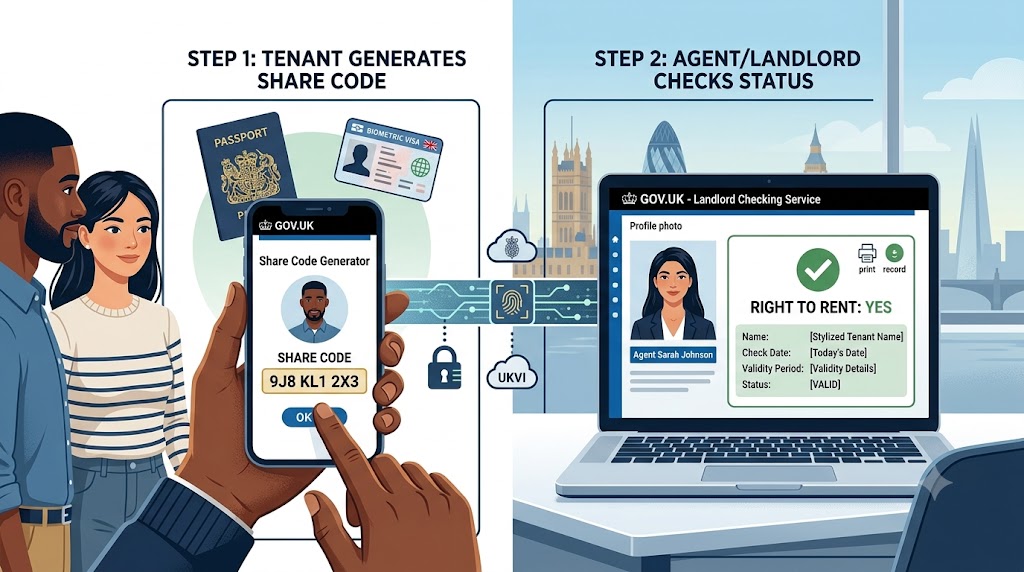
2. How the Right to Rent Process Works: Mechanics and Verification
Understanding the operational mechanics of the Right to Rent scheme requires looking closely at how verification actually happens in daily rental practice. A successful check is not merely an informal glance at an identity card; it is a standardized procedure that creates a verifiable legal paper trail known as a statutory excuse.
Key Thresholds and Metrics (Converted from Table)
· £10,000: First-offence civil penalty per illegal occupier.
· 18+: Age threshold for mandatory checks on all occupiers.
A. Who Must Be Checked?
A common misconception among housing providers is that checks only apply to foreign nationals or individuals with non-British accents. On the contrary, anti-discrimination guidelines mandated by the Home Office stipulate that checks must be conducted on all prospective adult occupiers aged 18 and older who will reside in the property as their main home, regardless of whether they are named on the formal tenancy agreement.
B. The Modern Verification Methods
The process of conducting a right to rent check has evolved significantly in recent years, shifting rapidly toward a fully digital ecosystem. Landlords and agents currently utilize three primary verification pathways:
1. The Online Share Code System: For individuals holding an online UKVI account (including holders of an eVisa, biometric residence status, or EU Settlement Scheme status), verification is completed digitally. The prospective tenant generates a temporary 9-character share code via the official UK government portal. The property owner or agent then inputs this code along with the applicant's date of birth into the online landlord checking service to view their right to rent status directly.
2. Physical Document Checks: For British and Irish citizens who do not use digital accounts, physical checks remain common. The landlord must inspect original, unexpired documents (such as a valid British or Irish passport) in the presence of the applicant (either in person or via live video link with the original physical document held in hand).
3. Identity Validation Technology (IDVT): Letting professionals and owners may also utilize certified identity document validation technology (IDVT) through registered identity service providers to remotely verify British and Irish passports, enhancing efficiency during remote onboarding.
Important Legal Note: Physical Biometric Residence Permits (BRPs) and Biometric Residence Cards (BRCs) are no longer accepted as valid proof for Right to Rent checks. Holders are required to register for a UKVI account to obtain a digital eVisa and generate an online share code.
C. Achieving a Statutory Excuse and Record Keeping
The main legal objective for a landlord or letting agent when carrying out this process is establishing a statutory excuse. If a landlord completes the check correctly before the tenancy commences and maintains proper records, they are legally protected against civil liability if it is later discovered that a tenant lied about their immigration clearance or subsequently lost their right to remain.
To retain this statutory defense, property managers must keep legible copies of all verified documents or online check result certificates (showing the photograph, full name, and date of check) for the duration of the tenancy and for at least one full year after the tenancy agreement has ended. All personal data must be stored securely in compliance with UK data protection regulations.
3. Why Right to Rent Exists: Its Purpose, Impact, and Legal Consequences
The Right to Rent framework serves a multi-faceted purpose within the United Kingdom's socio-economic structure, influencing immigration policy, housing regulation, and market integrity.
Requirements Comparison (Converted from Table)
Unlimited Right Holders:
· Target Group: British/Irish Citizens, ILR, Settled Status
· Initial Check Timing: Before granting the tenancy
· Follow-up Required?: No follow-up checks required
· Reporting Duty: None
Limited Right Holders:
· Target Group: Work Visas, Student Visas, Pre-Settled Status
· Initial Check Timing: Within 28 days prior to tenancy start date
· Follow-up Required?: Yes (at visa expiration or after 12 months)
· Reporting Duty: Must report to Home Office if visa expires
A. Financial Penalties and Criminal Sanctions
The primary mechanism ensuring compliance is a strict financial enforcement regime. Landlords or letting agencies who fail to perform adequate checks or knowingly allow unauthorized individuals to occupy property face severe financial hits under the updated civil penalty matrix:
· First Breaches: Up to £10,000 per illegal occupier or lodger.
· Repeat Breaches: Up to £20,000 per illegal occupier for subsequent offences.
In cases where property owners or letting managers knowingly rent to individuals who do not possess legal status or have reasonable cause to believe an occupier is unauthorized, enforcement can escalate to criminal prosecution, potentially resulting in unlimited criminal fines and up to five years in prison.
B. Safeguarding the Private Rented Sector
Beyond deterrence, the policy aims to raise professional standards across the private rented sector. By mandating rigorous identity and eligibility checks prior to handover, the government aims to disrupt rogue letting operations that exploit vulnerable migrants through overcrowding or sub-standard living conditions. It ensures that housing providers operate on a transparent, legal footing.
C. Preventing Discrimination and Ensuring Fair Access
Because the law imposes severe penalties, statutory guidance places equal weight on anti-discrimination compliance. Landlords and agents must apply identical checking procedures to every candidate. Making assumptions based on a person's accent, ethnicity, surname, or perceived national origin constitutes unlawful discrimination under the Equality Act 2010. By standardizing the check through universal digital processes or document lists, the framework aims to protect legitimate prospective tenants from bias during their house-hunting journey.

4. Special Scenarios: Subletting, Joint Tenancies, and Follow-up Checks
In practice, real-world tenancy arrangements can introduce complexities that require careful handling under Right to Rent rules:
Subletting and Assignment
When a tenant decides to sublet a room or assign their tenancy to another person, the primary tenant effectively assumes the legal role of a landlord. Unless the head landlord formally agrees in writing to take responsibility for conducting checks on the sub-tenant, the head tenant becomes liable for verifying the sub-tenant's right to rent and could face penalties for non-compliance.
Follow-up Checks for Time-Limited Visa Holders
When an occupier holds a limited right to rent, the statutory excuse obtained by the landlord is time-limited. To maintain legal immunity, the property owner or agent must perform a follow-up check before whichever is later:
· The date the tenant's permission to remain in the UK expires; or
· 12 months from the date of the previous check.
If a follow-up check reveals that a tenant no longer holds legal permission to reside in the UK, the landlord is not expected to immediately evict the occupant themselves. Instead, they must promptly submit an official report to the Home Office Landlord Checking Service. Submitting this report preserves the landlord's statutory excuse against civil fines while the authorities determine appropriate enforcement action.
5. Summary: Navigating Compliance Smoothly
The Right to Rent scheme is an inescapable component of letting residential property in England. For housing providers and property professionals, compliance is not merely an administrative nuisance—it is a vital operational safeguard that protects businesses and investments from severe financial liability. For prospective tenants, understanding how to generate an online share code or prepare official identity documents in advance ensures a swift, stress-free move-in process.
By leveraging online verification technology, maintaining meticulous digital records, and applying checks consistently without bias, participants in the UK property market can navigate Right to Rent obligations with confidence, transparency, and complete peace of mind.


