


Let’s be honest: renting out a property or moving into a new rented home is a bit like entering a long-term relationship. It starts with mutual agreement, a signed piece of paper, and the expectation that both parties will respect the boundaries set out before them. In the UK, this foundational document is most commonly an Assured Shorthold Tenancy (AST) agreement. It is the legal bedrock that outlines exactly what the landlord and the tenant are responsible for.
But we live in the real world, and things don't always go according to plan. People lose their jobs, pipes burst, miscommunications happen, and sometimes, the rules get broken. A breach of a tenancy agreement occurs when either the landlord or the tenant fails to uphold their end of the bargain. While landlords can certainly breach agreements (for instance, by failing to carry out essential repairs), this article will focus primarily on what happens when a tenant breaks the rules, looking through the lens of UK housing law. We will explore the most common issues, the legal consequences, the actions landlords can rightfully take, and the most pragmatic solutions to get things back on track.
Part 1: The Most Common Breaches by Tenants
When a tenancy goes sour, it is rarely out of the blue. Most breaches fall into a few predictable categories. Understanding these can help both landlords and tenants spot potential trouble before it escalates into a full-blown crisis.
1. Rent Arrears (Failing to Pay Rent)
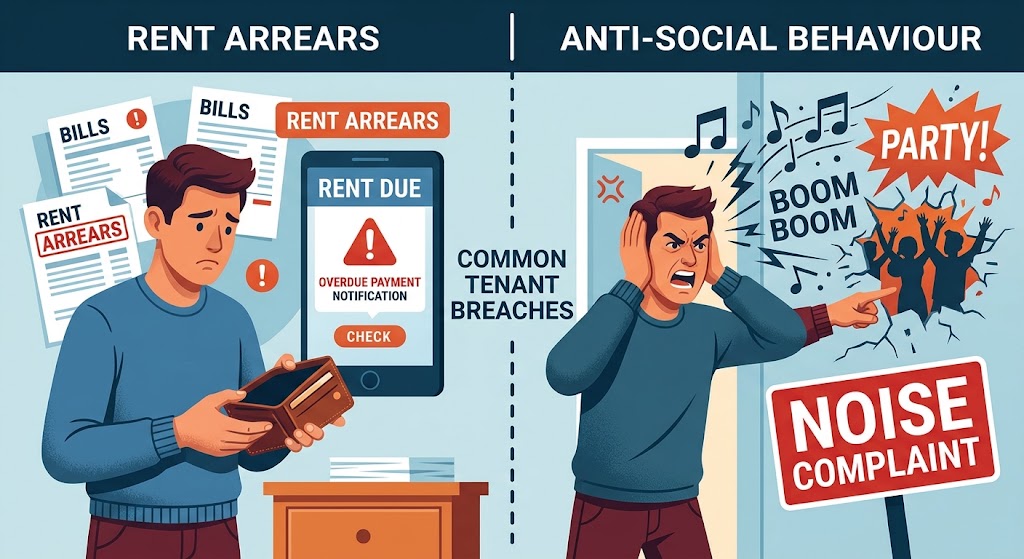
By far, the most common and stressful breach of a tenancy agreement is the failure to pay rent. For tenants, this is often the result of sudden life changes—a redundancy, a relationship breakdown, or a medical emergency. For landlords, especially those with buy-to-let mortgages, a tenant missing rent can instantly put their own financial stability at risk. The tenancy agreement explicitly states the amount of rent due and the date it must be paid. Even being a few days late constitutes a technical breach, though formal legal action usually requires a longer period of non-payment.
2. Anti-Social Behaviour and Nuisance
Everyone has the right to quiet enjoyment of their home, and this includes the neighbours. Tenancy agreements in the UK strictly prohibit anti-social behaviour. This umbrella term covers a multitude of sins: excessively loud music late at night, aggressive behaviour towards neighbours, illegal activities on the premises, or even leaving piles of rubbish rotting in the front garden. When a tenant causes a nuisance, the landlord often ends up fielding the complaints, putting them in a difficult position with the local council or community.
3. Unauthorized Subletting
With the rise of platforms like Airbnb, unauthorized subletting has become a major headache for UK landlords. A standard AST prohibits tenants from subletting the entire property or taking in lodgers without the landlord’s explicit written consent. When a tenant secretly sublets, they are not only breaching the contract but potentially invalidating the landlord's insurance policy and breaching the terms of the landlord's mortgage.
4. Keeping Pets Without Permission
The debate over pets in rented accommodation is deeply emotional. While the UK government has introduced guidelines encouraging landlords to be more open to pets (and the Renters' Reform Bill seeks to make it easier for tenants to keep them), standard contracts still usually require the landlord's permission. Sneaking a dog or cat into a property without asking is a direct breach and can lead to disputes over allergens, carpet damage, and deep-cleaning costs at the end of the tenancy.
5. Property Damage and Lack of Maintenance
Tenants are expected to treat the property in a "tenant-like manner." This means doing the little things: changing lightbulbs, unblocking sinks, and keeping the place reasonably clean and ventilated to prevent mould. While landlords are responsible for structural repairs and boiler maintenance under Section 11 of the Landlord and Tenant Act 1985, tenants are responsible for not actively damaging the property. Smashing a window, putting holes in the walls without permission, or letting the property fall into squalor are serious breaches.
Part 2: The Landlord’s Arsenal - Actions and Legal Consequences
When a tenant breaches the agreement, it can feel like a betrayal. However, UK law strictly dictates how a landlord can respond. The days of physically throwing a tenant out or changing the locks are long gone—such actions are classed as illegal eviction under the Protection from Eviction Act 1977 and can result in severe criminal penalties for the landlord. Instead, there is a clear, step-by-step legal process.
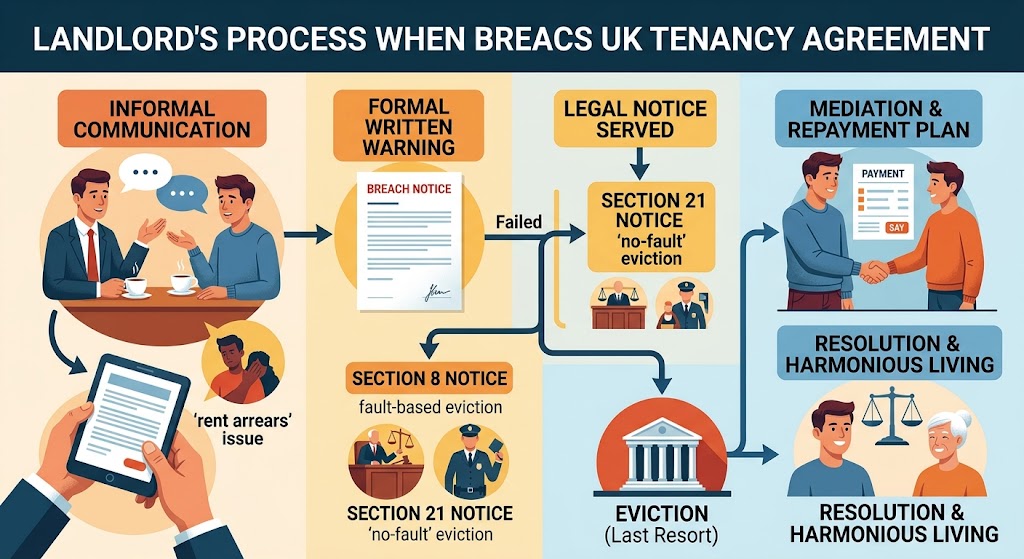
Step 1: Informal Communication and Fact-Finding
The most effective first step is always the most human one: talk to the tenant. If a rent payment is missed, a polite phone call or text message should be the first port of call. Perhaps there was a banking error, or the tenant is waiting on Universal Credit. If there is a noise complaint, the tenant might genuinely not realize how thin the walls are. A compassionate approach often yields faster results than an immediate legal threat.
Step 2: Formal Written Warnings
If informal chats fail, the landlord should escalate to a formal written warning. This letter should clearly state which clause of the tenancy agreement has been breached, provide evidence (e.g., "rent is 14 days late," or "neighbours reported a loud party on Friday"), and give a reasonable deadline to rectify the issue. This creates a paper trail, which is absolutely vital if the situation eventually goes to court.
Step 3: Serving a Section 8 Notice
If the tenant refuses to correct the breach, the landlord's primary legal tool is serving a Section 8 notice under the Housing Act 1988. This is a formal eviction notice used specifically when the tenant has broken the rules.
The Section 8 notice relies on specific "Grounds for Possession" laid out in the Act:
- Mandatory Grounds (e.g., Ground 8): If the tenant is exactly two months (or eight weeks) in rent arrears both at the time the notice is served and at the time of the court hearing, the judge must grant a possession order. The landlord is guaranteed to get their property back.
- Discretionary Grounds (e.g., Ground 10 for some rent arrears, Ground 12 for general breaches, Ground 14 for nuisance/anti-social behaviour): For these grounds, proving the breach isn't enough. The landlord must also convince the judge that it is reasonable and proportionate to evict the tenant based on the breach. Judges often give tenants a second chance if they promise to mend their ways.
Step 4: Serving a Section 21 Notice (The "No-Fault" Eviction)
Currently, in the UK, landlords also have the option of serving a Section 21 notice. Unlike Section 8, this does not require the landlord to prove a breach of contract; it simply allows them to reclaim the property at the end of a fixed term or during a periodic tenancy, provided they give at least two months' notice.
Many landlords prefer Section 21 even when a breach has occurred, because it avoids the need to argue the details of the breach in court. However, it’s worth noting that the UK government has been moving to abolish Section 21 under new rental reform legislation, which would make the Section 8 process the only route for eviction, placing a greater emphasis on proving the tenant’s fault.
Step 5: Court Proceedings and Bailiffs
If a notice (Section 8 or Section 21) expires and the tenant has not left or fixed the problem, the landlord cannot simply move their belongings out. They must apply to the County Court for a Possession Order. If the tenant still ignores the court order, the final step is applying for County Court Bailiffs to physically carry out the eviction. This entire process can take many months and cost thousands of pounds in legal fees, which is why eviction is always considered a last resort.
Part 3: The Tenant’s Perspective and Defences
It is important to view this from the other side. Tenants have significant rights in the UK. If a tenant is accused of a breach, they shouldn't panic, but they shouldn't ignore it either.
If faced with a Section 8 notice, tenants have the right to submit a defence to the court. For example, if a landlord claims rent arrears, but the tenant has been withholding rent because the landlord refused to fix a broken boiler (a dangerous tactic, but one that happens), the judge will take the landlord's failure to maintain the property into account.
Tenants facing eviction due to a breach are heavily advised to seek independent legal advice immediately. Charities like Shelter and organizations like Citizens Advice provide invaluable support, helping tenants negotiate repayment plans for rent arrears or mediate disputes over anti-social behaviour before it reaches a courtroom.
Part 4: Solutions and Preventative Measures
The ultimate goal for both parties should be a harmonious living arrangement, not a court battle. How can landlords and tenants resolve breaches peacefully?
1. Thorough Referencing and Clear Contracts
Prevention is better than a cure. Landlords must conduct rigorous reference and credit checks before handing over the keys. Furthermore, the tenancy agreement must be drafted in plain, easy-to-understand English. If a tenant doesn't understand the rules regarding pets or garden maintenance, they are more likely to inadvertently break them.
2. Regular Property Inspections
Landlords should conduct regular (e.g., every six months), pre-arranged property inspections. This allows them to spot unauthorized pets, early signs of damage, or sub-tenants before the situation spirals out of control. It also opens up a friendly dialogue, allowing the tenant to report minor repair issues.
3. Mediation and Repayment Plans
If rent arrears are the issue, drawing up a formal repayment plan is often the best solution. If the tenant pays their normal rent plus a small, agreed-upon amount towards the arrears each month, the landlord eventually gets their money without the massive expense of a court case. For behavioral disputes, independent mediation services can sit both parties down to iron out grievances in a neutral environment.
4. Utilizing the Deposit
For breaches discovered at the end of the tenancy (such as damage to furniture or deep cleaning required due to an unauthorized pet), the landlord can claim against the tenant's security deposit. In the UK, deposits must be held in a government-backed Tenancy Deposit Scheme (TDS). If the tenant disputes the deduction, the TDS offers a free, impartial adjudication service to resolve the matter based on the inventory and check-out reports.
Conclusion
A breach of a tenancy agreement is fundamentally a breakdown in communication and trust. While UK law provides a robust, heavily regulated framework to handle these breaches—primarily through the Housing Act 1988 and the Section 8 process—legal action should always be the final destination, not the starting point.
For landlords, reacting to a breach requires patience, meticulous record-keeping, and a strict adherence to legal protocols to avoid accusations of harassment. For tenants, a breach requires honesty, rapid communication, and a willingness to rectify the mistake. By approaching tenancy agreements not just as cold legal contracts, but as frameworks for a cooperative human relationship, both parties can navigate the pitfalls of renting with much less stress and hostility.


